Industrial wood grinding
Friction disc mill instead of a hammer mill for wood
For wood pellets and pre-shredded wood, a friction disc mill can be a technically and energetically relevant alternative to a hammer mill. The feed material, target fineness, throughput and complete plant process determine the right choice.
Up to 20% lower energy consumption
Compared with equivalent hammer mill technology. Actual energy consumption depends on the material, target fineness, throughput and plant design.
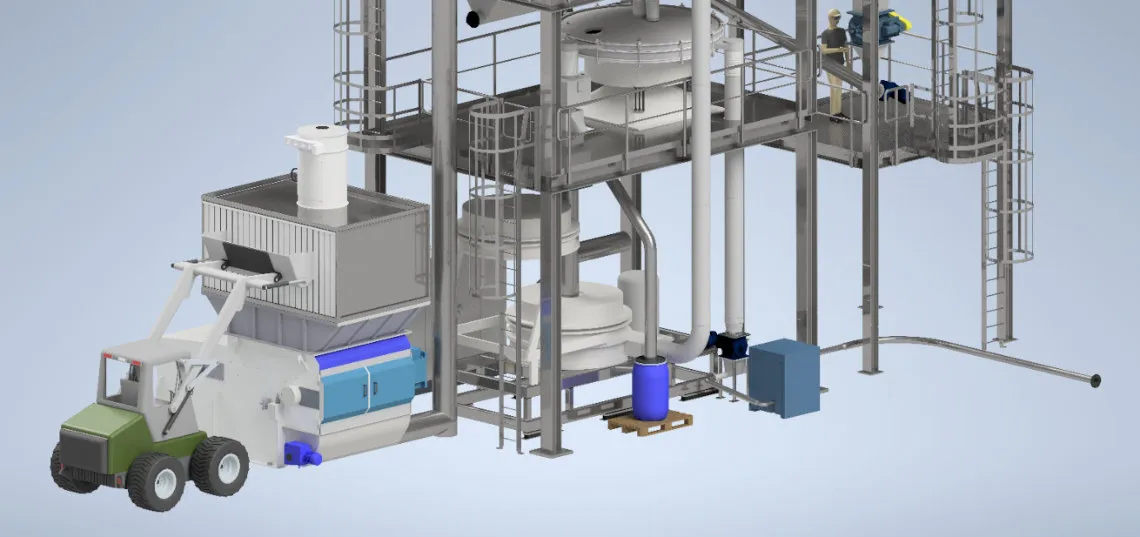
Which mill is suitable for grinding wood?
Hammer mills reduce wood through repeated impact. The material remains in the grinding chamber until it can pass through the installed screen. This established and flexible principle may require suitable extraction, filtration and recirculation equipment, depending on the task.
The friction disc mill developed further by Ingtec for wood grinding operates without an internal screen. Wood pellets or suitable pre-shredded wood pass through the grinding chamber once; the achievable fineness is controlled through the mill operating point.
Hammer mill and friction disc mill compared
The following comparison shows the design differences. It does not replace project-specific engineering.
| Criterion | Hammer mill | Friction disc mill |
|---|---|---|
| Size-reduction principle | Repeated impact grinding in the grinding chamber | Grinding between friction discs in a single pass |
| Fineness control | Screen perforation, tools and rotational speed | Mill operating point and rotational speed |
| Internal screen | Required and subject to wear | Not required |
| Material flow | Remains in the grinding chamber until it passes through the screen | Single pass through the grinding gap |
| Ancillary equipment | Often requires extraction, filtration and material recirculation | A more compact design may be possible, depending on the project |
| Suitable feed | Depending on the design, also heterogeneous or coarser wood fractions | Wood pellets and suitable pre-shredded wood |
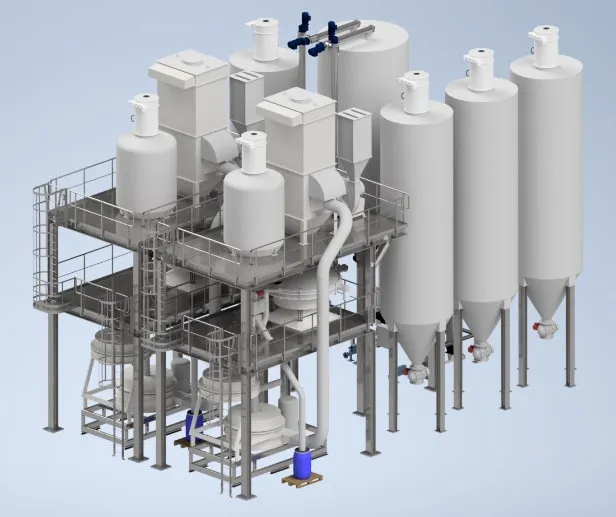
Documented large-scale trial
320 tonnes of wood pellets ground under industrial conditions
The trial setup combined the friction disc mill with two alternately operated Big Bag filling stations. As rotational speed increased, fineness increased while throughput decreased.
- wood pellets ground
- 320 t
- throughput at 40 Hz
- approx. 19 t/h
- throughput at 50 Hz
- approx. 12 t/h
- temperature increase during the trial
- approx. 10 °C
The documented values come from a specific trial with wood pellets and are not general performance guarantees. The trial documents state energy figures, including the two feed screws, of approximately 5 kW/t at 40 Hz and approximately 7.5 kW/t at 50 Hz.
When is a friction disc mill suitable for wood?
A friction disc mill is particularly relevant when a defined wood product is to be continuously ground into wood flour and energy demand, maintenance points and ancillary equipment are to be optimised together.
Typical starting conditions
- Wood pellets or suitable pre-shredded wood
- Feed size up to approximately 3 mm
- Target particle size below 2 mm, depending on the operating point
- Continuous industrial wood grinding
- Wood flour for thermal processes and alternative fuel concepts
To be assessed for each project
- Wood type, moisture and feed-material variations
- Required particle-size range and hourly throughput
- Fire, explosion and occupational safety
- Feeding, dosing, discharge and downstream conveying
- Suitability of a hammer mill for coarser or heterogeneous feed material
Complete plant rather than an isolated machine
Grinding wood means engineering the material flow
Ingtec treats the mill as part of a complete plant. Stable throughput and product quality require feeding, grinding, discharge, conveying, storage and the downstream process to be coordinated.
- 01
Characterise the material
Record wood type, moisture, feed size and expected variation.
- 02
Define the target
Specify particle-size range, throughput, temperature limits and downstream process.
- 03
Compare processes
Assess hammer mill and friction disc mill against the actual task.
- 04
Engineer the plant
Integrate feeding, mill, discharge, conveying, controls and safety.
Frequently asked questions about hammer mills for wood
Which mill is suitable for wood pellets?
A friction disc mill can be an alternative to a hammer mill for grinding wood pellets. Whether it is technically and economically suitable depends in particular on target fineness, throughput and the downstream process.
What is the difference between a friction disc mill and a hammer mill?
A hammer mill repeatedly subjects the material to impact and discharges it through a screen. A friction disc mill operates without an internal screen and grinds the material in one pass between friction discs.
Does a friction disc mill use less energy?
The documented comparison found energy consumption to be up to 20% lower than with equivalent hammer mill technology. The transferable energy demand must be determined for the material, fineness, throughput and complete plant.
How finely can wood be ground with a friction disc mill?
The available trial data states an adjustable fineness below 2 mm. A target particle size of 0.5 mm or below can be achieved by combining multiple grinding stages. The specific design depends on the material.
Can Ingtec supply a complete wood-grinding plant?
Yes. In addition to the mill, Ingtec engineers feeding, dosing, discharge, conveying, storage, controls and the interfaces to the downstream process.
Plant engineering consultation
Assess a hammer mill or friction disc mill for your wood product
Send us information about the wood type, moisture, feed size, required fineness and hourly throughput. We will review the task and discuss a suitable plant concept.