Dilute-phase conveying in suction or pressure operation
Dilute-phase conveying systems transport bulk solids and unit loads with low product loading, large air volumes and high flow velocities. Depending on the material and conveying distance, the conveying velocity is approximately 20 to 30 m/s.
The process is not suitable for sensitive, abrasive or adhesive bulk solids. Light, free-flowing bulk solids such as plastic granules, wood pellets or wood dust can be transported using dilute-phase conveying.
Engineering the dilute-phase conveying system
The velocity in the pipeline must be high enough to prevent the conveyed material from settling. The suspension velocity of the material and the pressure loss during conveying are therefore determined first.
Pressure loss is influenced by factors including pipeline length, pipe diameter, and the number and geometry of bends. These values form the basis for calculating the required conveying air volume and conveying pressure.
Suction conveying under negative pressure
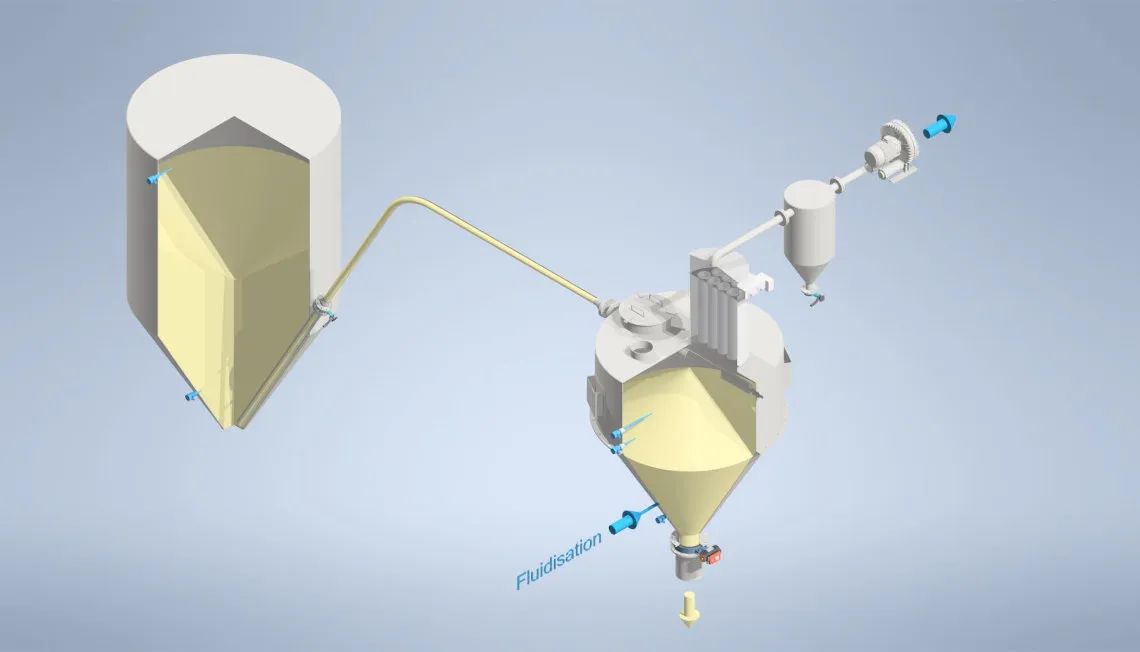
In suction conveying, the fan or blower, together with the filter and safety filter, is located at the end of the conveying process and generates the conveying air flow by means of negative pressure.
The product is introduced into the air flow through a suction lance, feed shoe or rotary valve. This process is used primarily for readily conveyable bulk solids and shorter distances than dilute-phase conveying with positive pressure.
Pressure conveying with positive pressure
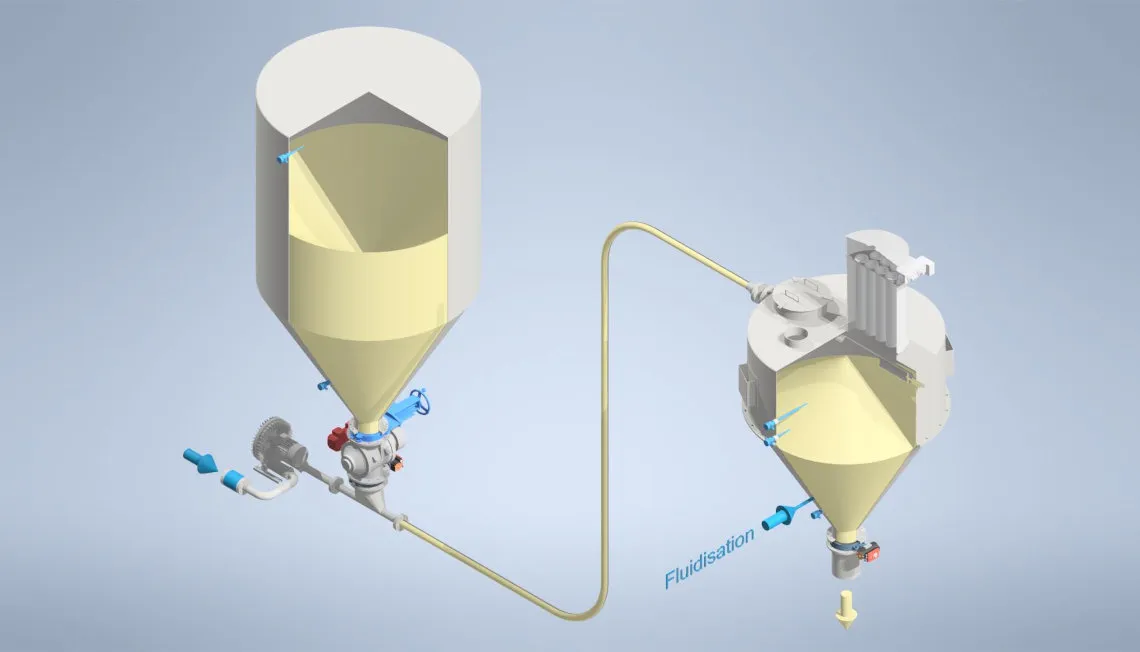
In pressure conveying, the conveying air is supplied at the start of the conveying line under positive pressure. Dilute-phase conveying systems operate with blowers at pressures of up to approximately 0.8 bar.
Feeding and conveying air generation
Blowers, fans, side-channel blowers or rotary lobe blowers are used to generate the conveying air. The material is metered into the air flow through a feed shoe or rotary valve.
Further pneumatic conveying principles and the distinction from dense-phase conveying are described in the overview of pneumatic conveying systems.